Choose the activation, cable, plug and use status that suit your theatres, then confirm the TGA supply route 🌏
In an Australian operating theatre the cautery pencil, often called the diathermy pencil, is one of the most frequently opened items on the trolley. For hospital buyers, day-surgery groups and medical distributors, it is also one of the easiest items to get slightly wrong. A pencil with the wrong plug for the generator, a 3 m cable where the theatre layout needs 5 m, or reusable stock arriving when the facility runs single-use: each of these turns a routine order into a return.
This guide covers cautery pencils for Australia from a purchasing point of view. It sets out the options Cosil Instruments manufactures, the details Australian buyers should specify, and how the Therapeutic Goods Administration’s sponsor and ARTG requirements shape the way an overseas-made pencil reaches an Australian theatre.
Quick answer: Cautery pencils for Australian supply should be specified by activation type (hand-control or foot-control), cable length, generator-side plug, electrode shaft size and use status (reusable or single-use). Cosil manufactures hand-control and foot-control cautery pencils with 3 m and 5 m cables and several plug options, in multi-use and single-use versions. Before supply, the device must be included in the ARTG by an Australian sponsor, unless an exemption applies.
Hand-Control or Foot-Control?
The first decision is how the surgeon activates the pencil.
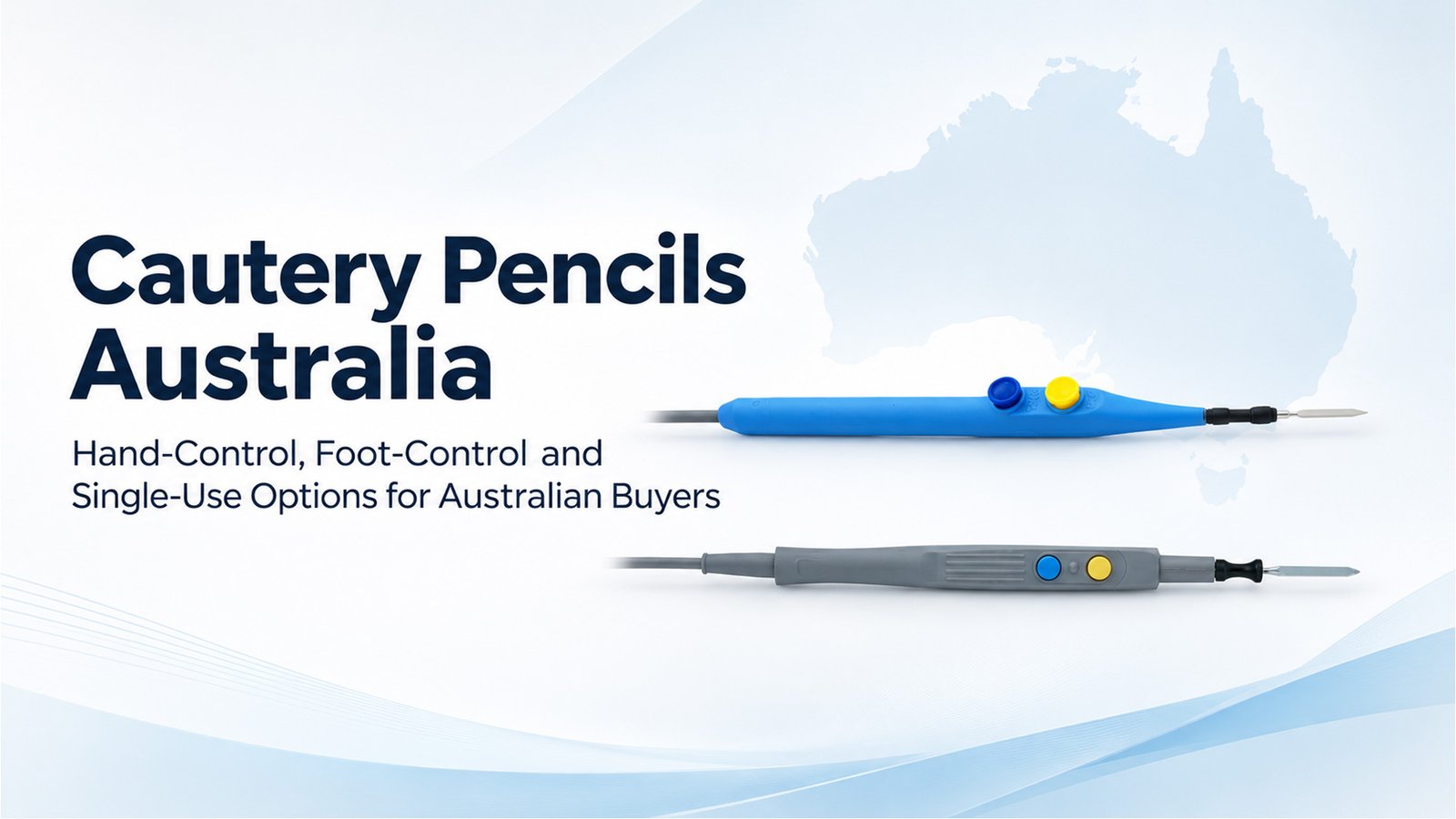
- Hand-control pencils have buttons on the handpiece, so the surgeon activates cut or coagulation directly from the pencil.
- Foot-control pencils have no buttons on the handpiece; activation comes from a foot switch connected to the generator.
Many theatres use hand-control pencils as standard, while foot-control pencils are kept for surgeons or procedures that require them. The choice is clinical, but it has a direct effect on what procurement buys: a foot-control pencil only works where a compatible foot switch is available.
Our comparison of hand-control and foot-control cautery pencils explains the differences in more detail.
Key insight: Record the activation type with the generator model. A foot-control pencil ordered for a theatre without a matching foot switch is the most avoidable return on the list.
Cosil Cautery Pencil Options
Cosil’s current catalogue lists the following cautery pencil options. Exact references, plug descriptions and pack formats should be confirmed for each item.
| Option | What the catalogue lists | What to confirm |
| Hand-control cautery pencil | Multi-use and single-use versions | Button layout, plug, cable length |
| Foot-control cautery pencil | Multi-use and single-use versions | Foot switch availability, plug |
| Cable length | 3 m and 5 m versions | Theatre layout and generator position |
| Generator-side plug | Several pin sizes and an international three-pin plug, grouped by generator series | Generator make and model |
| Pack format | Boxes of 20 units for many references | Pack size suits usage |
| Electrode shaft | Electrodes listed on 2.4 mm and 4 mm shafts | Shaft size the pencil accepts |
| Detachable handpieces | Listed on Cosil’s cautery pencil range | Detachable cable and handpiece pairing |
The pencils are listed with a maximum voltage rating (Umax) of 0.5 kVp, and the reusable versions as autoclavable. See our main cautery pencil page for the full range.
Plugs, Cables and Generator Compatibility
The generator-side plug decides whether a pencil can be connected at all. Cosil groups its plug options by generator series, and lists several pin sizes as well as an international three-pin plug.
When requesting pencils for an Australian facility, provide:
- the generator manufacturer and full model name for each theatre;
- a photograph of the monopolar socket and the plug currently in use;
- the cable length the theatre prefers;
- the electrode shaft size currently in use.
As with any accessory, a plug that fits physically has not, on that basis alone, been shown to be suitable for the generator. Check the generator manufacturer’s accessory information and involve the biomedical engineering team where your facility requires it. Our electrosurgery equipment compatibility guide covers these checks.
Reusable or Single-Use Pencils?
Australian facilities use both. The decision usually depends on infection-prevention policy, the capacity of the sterilising services department and case volume.
Reusable pencils
Reusable pencils are cleaned and sterilised between uses according to their instructions for use and the facility’s reprocessing procedures. Before approval, request the reference’s reprocessing information, including inspection points for the cable, buttons and electrode socket.
Single-use pencils
Single-use pencils remove the reprocessing step and suit high-turnover lists and day-surgery settings. They add a recurring consumable cost. Confirm whether each reference is supplied sterile, how it is packed and how batches are identified.
Our guide to detachable and single-use cautery handpieces compares the two approaches in more depth.
Key insight: “Single-use” and “sterile” are separate attributes. Confirm sterile status from each reference’s labelling before it is approved for theatre.
Electrodes That Go With the Pencil
A pencil is only half of the active side. Australian buyers usually order electrodes at the same time. Cosil’s catalogue lists needle, knife, blade, lancet, ball and loop electrodes, non-stick electrodes, microdissection needle electrodes and longer shaft options, many in multi-use and single-use versions.
Match the electrode shaft size to the pencil before ordering. See our page on diathermy electrodes for Australian buyers for the electrode range.
The TGA Supply Route for Cautery Pencils
In Australia, medical devices are regulated by the Therapeutic Goods Administration (TGA). For buyers sourcing from an overseas manufacturer, the key points are:
- Australian sponsor. A medical device must generally be included in the Australian Register of Therapeutic Goods (ARTG) before it is supplied, and the application is made by an Australian sponsor. An overseas manufacturer supplies the Australian market through a sponsor.
- ARTG inclusion. Check that the device you plan to buy is covered by a current ARTG entry held by the sponsor you are buying from. ARTG entries can be searched publicly.
- Overseas evidence. The TGA accepts certain evidence from comparable overseas regulators and assessment bodies to support an ARTG application, but only for the same device with the same design and intended purpose.
- Ask for the labelling, instructions for use and any reprocessing information supplied with the device in Australia.
For distributors, this usually means either acting as the sponsor or working with a sponsor who holds the ARTG inclusion. Cosil does not claim ARTG inclusion on its website, so the sponsor arrangement for any reference should be agreed before supply.
Cosil’s website refers to CE certification with SGS Belgium as notified body, ISO 13485:2016 and EUDAMED registration, and notes that MDR certification is in progress. Request current certificates and check that their scope covers the pencils you plan to list.
Supply Notes for Australian Hospitals and Distributors
Hospitals and day-surgery centres should hold separate stock codes for hand-control and foot-control pencils, for 3 m and 5 m cables, and for reusable and single-use versions. Planning by generator model avoids plugs that do not match.
Distributors can present the range by activation type first, then cable length and plug, then use status. Pencils, electrodes and return electrodes are often sold together; see our page on diathermy accessories for Australia and the wider guide for Australian distributors of surgical instruments.
Cautery pencils can also be included in procedure packs; see procedure packs for Australia. For generators and connected equipment, see electrosurgery equipment in Australia, and for Cosil’s wider Australian supply, electrosurgical instruments manufacturer for Australia.
How to Request Cautery Pencil Information
Include in your enquiry:
- hand-control, foot-control or both;
- cable length (3 m or 5 m);
- generator make and model, with plug photographs;
- electrode shaft size;
- reusable, single-use or both;
- estimated annual quantities;
- your sponsor arrangement, or whether you need to discuss one.
Frequently Asked Questions
Is a cautery pencil the same as a diathermy pencil?
Yes. In Australia the terms “cautery pencil”, “diathermy pencil” and “electrosurgical pencil” are often used for the same handpiece that holds the active electrode in monopolar electrosurgery.
Does Cosil make foot-control cautery pencils?
Yes. Cosil’s catalogue lists foot-control cautery pencils alongside hand-control pencils, in multi-use and single-use versions. A compatible foot switch is needed to activate them.
Which cable lengths are available?
Cosil lists cautery pencils with 3 m and 5 m cables. Choose the length that suits the theatre layout and the generator’s position.
Can an overseas manufacturer supply cautery pencils directly to an Australian hospital?
Medical devices generally need to be included in the ARTG by an Australian sponsor before supply. Buyers should confirm the sponsor and ARTG entry for the specific device before ordering.
Are reusable pencils autoclavable?
Cosil lists its reusable pencils as autoclavable. Follow the reference’s reprocessing instructions and your facility’s sterilising procedures.
Can cautery pencils be included in procedure packs?
Yes, where the pack is designed around a known generator and plug type. The pack specification should name the exact pencil reference.
Getting the Basics Right
A cautery pencil is a simple device with several details that must match: activation, cable, plug, shaft and use status. Australian buyers who settle those details, and confirm the sponsor and ARTG route early, can rely on routine reorders without surprises.
Sourcing hand-control or foot-control cautery pencils for Australian hospitals or distribution? Contact Cosil Instruments at sales@cosilinstruments.com or +92 331 732 7777, or send an enquiry, to request product information and a quotation.