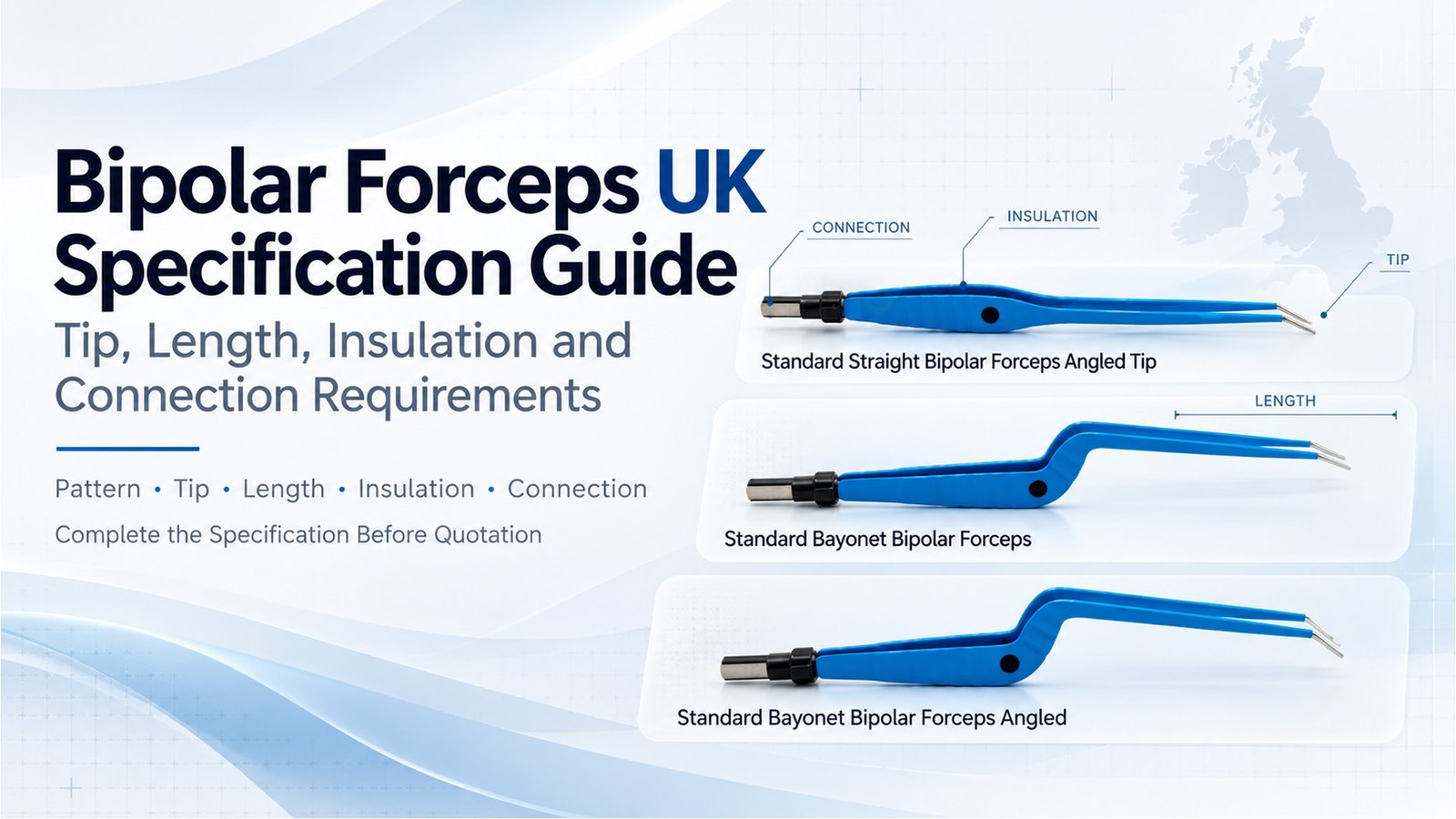
The specification details UK hospitals and distributors should settle before a bipolar forceps quotation, and why each one changes what you receive
Most problems with bipolar forceps in the UK supply chain do not come from the instrument itself. They come from an incomplete specification. A quotation request that says “bipolar forceps, bayonet, 20 cm” can be answered with several different products, and the difference only becomes visible when stock arrives in theatre or a distributor’s customer questions a substitution.
This guide sets out the details UK hospital procurement teams, theatre managers and distributors should define when specifying bipolar forceps. It covers product family, pattern, tip, length, configuration, insulation, cable, connector and generator information. It is written to be used alongside a supplier conversation, so the reference you approve is the reference you keep receiving.
Quick answer: A complete UK bipolar forceps specification identifies the product family, pattern, tip geometry, overall length and configuration (straight, angled or bayonet), insulation requirement, cable arrangement, instrument and generator-end connectors, and the generator in use. It is tied to a single product reference. Physical connector fit and product-family descriptions should never be treated as confirmation of compatibility or specification.
What a Complete Bipolar Forceps UK Specification Contains
Each field below narrows the request towards one product. Leaving a field blank does not keep options open. It passes the decision to whoever processes the order.
| Specification field | What to state | Risk if left undefined |
| Product family | Standard, C-Tech, non-stick, special or irrigation, as listed | Quotation compares products that are not equivalent |
| Pattern | For example McPherson, Jeweller or Adson, where listed | Handling differs from what the clinical team expects |
| Tip | Tip geometry and dimensions as shown for the reference | Near-match instrument supplied |
| Length and configuration | Overall length; straight, angled or bayonet | Separate code ordered; reach does not suit the procedure |
| Insulation | Insulation requirement for the reference | Assumptions made about coverage |
| Cable and connectors | Cable arrangement, instrument-end and generator-end connectors | Instrument cannot be connected, or connects without confirmed compatibility |
| Generator | Manufacturer and model in use | Compatibility cannot be reviewed |
Starting with the Bipolar Forceps Product Family
Cosil’s bipolar range is organised into families, and UK specifications should name the family before any dimensions. Families can include standard bipolar forceps, C-Tech Bipolar Instruments, non-stick bipolar forceps, special bipolar forceps and irrigation forceps. Not every pattern, tip, length or connector is available in every family. For that reason, the family has to be confirmed first, and the other details are then chosen from what that family actually offers.
Where a team is choosing between a non-stick instrument and a specialist configuration, our comparison of non-stick and special bipolar forceps covers that decision in detail. For a broader overview of standard, non-stick and special options, see the bipolar forceps guide.
Pattern and Tip Dimensions
Naming the pattern
Pattern names such as McPherson, Jeweller and Adson are widely understood in UK theatres. They describe the overall instrument style, not every dimension. A request should name the pattern and then specify the tip separately, as listed for the chosen reference.
Specifying the tip
Tip geometry is where substitutions most often go unnoticed. If the requirement comes from an instrument already in use, record its full reference, or provide a clear description or image of the tip, with the quotation request. For distributors, keeping the tip description in the catalogue record prevents customers from treating two similar codes as interchangeable.
Length and Straight, Angled or Bayonet Configuration
Overall length and configuration together decide reach and working angle. Straight, angled and bayonet forms suit different access needs, and the clinical team should make that choice. Procurement’s job is to make sure it is recorded accurately.
State length in the unit the reference uses and avoid rounding. If the same pattern is needed at two lengths, treat them as two separate specification lines, each with its own reference and forecast quantity.
Insulation Requirements
Insulation on bipolar forceps limits where energy can reach and forms part of the instrument’s design. A specification should confirm the insulation arrangement for the reference being quoted, not assume it from the family name or from another supplier’s product.
For reusable instruments, UK hospitals will normally inspect insulation as part of their own decontamination and inspection procedures. When approving a reusable reference, it is reasonable to ask for its instructions for use, so inspection and reprocessing steps can be checked against local processes before the instrument enters circulation.
Connection, Bipolar Cable and Generator Information
Bipolar forceps operate as part of a chain: the instrument, the bipolar cable, the generator-end connector and the generator. A UK specification should describe every link in that chain.
Cable arrangement
State whether the forceps connect to a separate reusable bipolar cable or are supplied with a cable attached. If a separate cable is used, the cable becomes its own specification line with its own reference.
Connectors
Identify both the instrument-end connection and the generator-end connector. A connector that fits a socket is not proof that the combination is electrosurgically compatible. The pairing of forceps reference, cable reference and generator model should be confirmed, with review by the hospital’s clinical engineering team where local policy requires it.
Generator details
Include the generator manufacturer and model for each site. For distributors serving several UK customers, record generator information per customer so the right connector variant is quoted each time. The electrosurgery equipment compatibility guide explains how generators, cables, pads and accessories should be checked together.
Reference Identification: One Specification, One Product Code
Once the fields above are agreed, they should resolve to a single product reference. That reference, not a description, should appear on the purchase order, in the hospital’s product file and in any distributor catalogue.
- Do not transfer dimensions, documentation or regulatory information from one reference to another, even within the same family.
- Record the reference alongside the cable and connector references it has been confirmed with.
- Treat any proposed alternative as a new specification line requiring its own approval.
Preparing a Bipolar Forceps Quotation Request in the UK
For UK hospitals and theatre procurement teams
A strong request lists each instrument as a separate line with every specification field completed, the generator in use, the expected annual quantity, the delivery location, and the documentation the trust or private hospital needs for product approval. Buyers should confirm the current regulatory status of each reference for the UK market as part of their own compliance review.
For UK distributors
Distributors benefit from grouping requests by product family and noting which lines are core stock and which are supplied to order. Sharing forecast quantities per reference, and any private-label requirements, helps build a quotation that reflects how the range will actually move. For wider sourcing context, see our guide to electrosurgical forceps supply in the UK.
| Example specification line | Entry |
| Product family | As listed (for example non-stick) |
| Pattern | As listed under that family |
| Tip | As shown for the reference |
| Length and configuration | As listed; bayonet, straight or angled |
| Cable arrangement | Separate cable (with cable reference) or attached |
| Generator | Manufacturer and model |
| Annual quantity and delivery site | Buyer to complete |
| Documentation required | Buyer to complete |
Once the specification is ready, the Bipolar Forceps Supplier UK page explains how Cosil supports UK hospitals, clinics and distributors with supply.
Getting the Bipolar Forceps UK Specification Right First Time
A well-built specification is the cheapest risk control in bipolar forceps procurement. By naming the family, pattern, tip, length, configuration, insulation, cable, connectors and generator, and resolving them to one reference, UK buyers can compare quotations fairly and receive consistent stock. Product suitability remains a decision for the buyer’s clinical, technical, procurement and compliance teams.
Frequently Asked Questions
What is the minimum information needed to quote bipolar forceps in the UK?
Product family, pattern, tip, length and configuration, cable arrangement, generator-end connector, generator model, quantity and delivery location. Documentation requirements should be included if product approval is needed.
Are non-stick and special bipolar forceps specified the same way?
The same fields apply, but the available patterns, tips and lengths depend on the family. Confirm the family first, then select from what that family lists.
Does a matching connector mean the forceps will work with our generator?
No. Physical fit does not confirm electrosurgical compatibility. The forceps, cable and generator combination should be confirmed and reviewed under your local processes.
Can we reuse the specification from a similar instrument?
Only as a starting point. Specifications, documentation and regulatory information belong to a specific reference and should not be transferred to another.
How should distributors record bipolar forceps in their catalogue?
Give each reference its own code, with family, pattern, tip, length, configuration and confirmed connector details recorded against it. This prevents similar instruments being treated as substitutes.
Send Your Bipolar Forceps UK Specification for Review
If you are preparing a bipolar forceps requirement for a UK hospital, clinic or distribution range, send your specification lines, generator details and forecast quantities to sales@cosilinstruments.com. Cosil can help confirm references before quotation. You can also browse the range at Cosil Instruments.