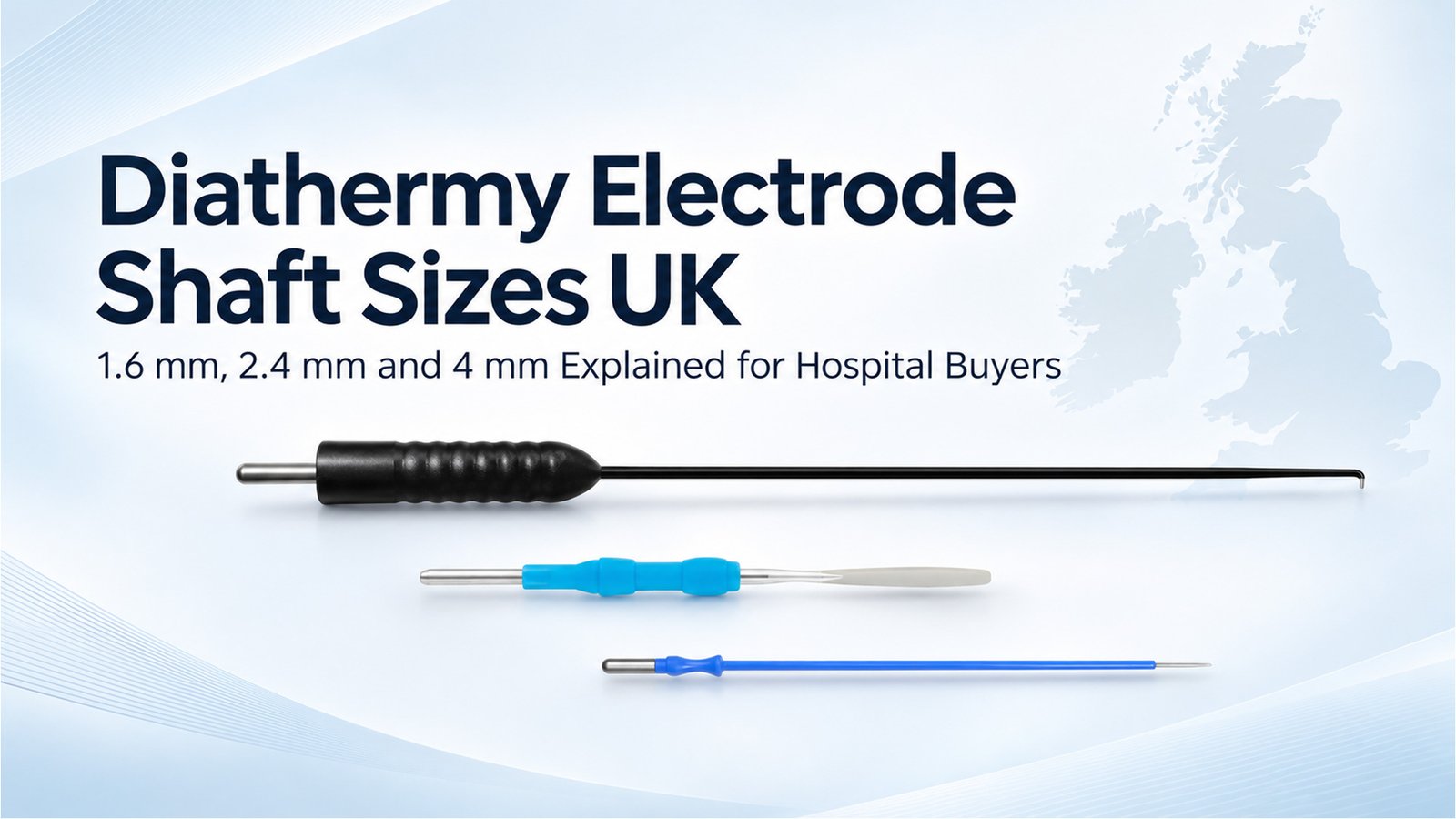
The working end gets the attention, but the shaft decides whether the electrode fits the handpiece at all 📏
Most diathermy electrode requests describe the working end: a needle, a blade, a ball, a loop. Far fewer mention the shaft, the plain section that slides into the handpiece. Yet the shaft is the first thing that has to be right. If it is the wrong diameter, the electrode will not seat in the cautery pencil, however well the tip suits the procedure.
For UK hospitals, independent clinics and distributors, diathermy electrode shaft sizes cause more avoidable returns than almost any other accessory detail. Several diameters are in common use, two of them differ by only a few hundredths of a millimetre, and catalogues do not always describe them the same way.
This guide explains the shaft sizes listed in Cosil Instruments’ catalogue, how to identify the size your handpieces accept, when extensions and longer shafts are useful, and how to keep shaft size visible in stock codes and orders.
Quick answer: Diathermy electrodes are made with different shaft diameters, and each handpiece accepts only the size it was designed for. Cosil’s catalogue lists electrodes on 1.6 mm, 2.38 mm, 2.4 mm and 4 mm shafts, in standard and longer working lengths, plus extensions that let some smaller shafts be used in larger handpiece sockets. UK buyers should confirm the shaft size their cautery pencils accept and record it on every electrode stock code.
Why Shaft Size Is the First Specification Point
An electrode has three parts that matter to a buyer: the shaft that fits the handpiece, the insulated or bare section along its length, and the working end. The working end is a clinical choice. The shaft is a compatibility requirement.
A UK theatre may hold pencils from more than one manufacturer, bought at different times. If one accepts a 2.4 mm shaft and another a 4 mm shaft, a single “standard blade electrode” cannot serve both. Ordering by working end alone almost guarantees that some stock will not fit.
Key insight: Write the shaft diameter in millimetres on every electrode request. “Standard shaft” means different things in different hospitals.
Shaft Sizes in Cosil’s Diathermy Electrode Catalogue
| Shaft size listed | Examples of electrodes on this shaft | Notes for buyers |
| 1.6 mm | Fine needle, wire loop and ball electrodes | Smaller diameter; check handpiece acceptance |
| 2.38 mm | C-Tech active monopolar electrodes, including needle, blade, wire loop and ball | 2.38 mm is the metric equivalent of 3/32 inch |
| 2.4 mm | Needle, knife, blade, lancet, ball, spatula, wire loop, ribbon loop and microdissection electrodes | Often treated as equivalent to 2.38 mm; confirm with the handpiece |
| 4 mm | Needle, knife, lancet, spatula, ball, wire loop and ribbon loop electrodes, insulated needles | Larger diameter used by some handpiece designs |
Many references are available in multi-use and single-use versions, and electrodes are commonly packed in boxes of 50 units. Confirm the exact shaft, working-end dimensions and pack format for each reference.
For the full electrode range, see our diathermy electrodes for UK buyers and the main diathermy electrode page.
2.38 mm and 2.4 mm: Close, but Confirm
Two of the listed sizes, 2.38 mm and 2.4 mm, differ by only 0.02 mm. The 2.38 mm figure is the metric equivalent of a 3/32 inch shaft, a size widely used for monopolar electrodes, and many suppliers round it to 2.4 mm.
In practice, the two are often used in the same handpieces. Even so, buyers should not assume interchangeability. Ask the handpiece manufacturer or supplier which shaft diameter the pencil is designed to accept, and test fit a sample before committing to volume.
How to Identify the Shaft Size Your Handpieces Accept
The most reliable sources, in order:
- The handpiece’s instructions for use or technical data, which usually state the accepted electrode shaft.
- The reference of electrodes already in use with that handpiece, if they fit and are approved.
- A measured sample, using a calibrated gauge, sent with photographs to the supplier.
Record the result against each handpiece reference, not against the department. One theatre suite can hold several pencil types.
Our guide to cautery pencils for UK theatres and the comparison of hand-control and foot-control cautery pencils explain how pencils are specified.
Key insight: Pair every electrode reference with the handpiece reference it has been fitted to. That single link prevents most shaft-size returns.
Extensions and Longer Shafts
Shaft extensions
Cosil’s catalogue lists extensions that allow an electrode with a smaller shaft to be used in a handpiece socket designed for a larger one. Examples include a 4 mm extension that accepts a 2.4 mm electrode, a 4 mm extension that accepts a 1.6 mm electrode, and a 2.4 mm extension that accepts a 1.6 mm electrode.
Extensions can reduce the number of electrode lines a department holds, but they add a connection. Before approving one, confirm with clinical engineering that the combination is acceptable, and request the reference’s instructions for use and reprocessing information.
Longer working lengths
Some procedures need more reach than a standard electrode provides. Cosil lists electrodes with longer overall lengths, including 140 mm and 160 mm versions of ball, needle, lancet and loop electrodes on 2.4 mm and 4 mm shafts. Specify the overall length in millimetres alongside the shaft diameter.
Insulation Along the Shaft
Some electrodes are insulated along part of their length so that only the working end is exposed. Cosil’s catalogue includes insulated needle electrodes, including 45° angled versions, and a needle electrode with ceramic insulation and a tungsten needle.
Where insulation is part of the design, ask for:
- the extent of the insulated section;
- inspection criteria for reusable electrodes;
- reprocessing instructions that cover the insulation.
Our guide to specialised electrosurgical electrodes covers insulated and specialist designs in more detail.
Organising Stock Around Shaft Size
For UK hospitals:
- include the shaft diameter in the stock description, for example “Ball electrode 4 mm, 2.4 mm shaft, single-use”;
- store electrodes for different shaft sizes in separate, clearly labelled locations;
- keep multi-use and single-use electrodes under different codes.
For UK distributors:
- present electrodes by shaft size first, then working end;
- show compatible handpiece references where known;
- offer extensions as separate lines, with clear “accepts / fits” descriptions.
Our page on diathermy accessories supply in the UK shows how electrodes fit into a wider accessory range. Electrodes can also be specified within procedure packs for UK hospitals, where the pack names a fixed handpiece and shaft size.
UK Documentation and Supplier Checks
UK buyers should request the declaration of conformity, labelling and instructions for use for each electrode reference, plus reprocessing information for multi-use versions. For devices placed on the Great Britain market, UK Responsible Person, MHRA registration and post-market surveillance duties continue to apply. On 21 October 2026 the UK government confirmed it intends to legislate for indefinite recognition of devices CE-marked under the EU MDR; check the current position at tender time.
Cosil’s website refers to CE certification with SGS Belgium as notified body, ISO 13485:2016 and EUDAMED registration, and notes that MDR certification is in progress. Request current certificates and check that their scope covers the electrodes you plan to buy. Our quality policy sets out Cosil’s approach.
How to Request Electrode Information by Shaft Size
Include in your enquiry:
- the handpiece manufacturer and reference;
- the accepted shaft diameter, if known, or a measured sample;
- working end and dimensions;
- overall length, standard or long;
- multi-use or single-use;
- estimated quantities and pack format;
- documents needed for approval.
Frequently Asked Questions
Which diathermy electrode shaft sizes does Cosil supply?
Cosil’s catalogue lists electrodes on 1.6 mm, 2.38 mm, 2.4 mm and 4 mm shafts, across needle, blade, knife, lancet, ball, spatula, loop and specialist designs.
Are 2.38 mm and 2.4 mm shafts the same?
They are very close: 2.38 mm is the metric equivalent of 3/32 inch, and many suppliers round it to 2.4 mm. Confirm with the handpiece documentation and a sample fit before ordering in volume.
Can a 2.4 mm electrode be used in a 4 mm handpiece?
Not directly. Cosil lists a 4 mm extension that accepts a 2.4 mm electrode. Any extension should be approved by clinical engineering and used according to its instructions.
Are long diathermy electrodes available?
Yes. Cosil lists longer electrodes, including 140 mm and 160 mm versions of several designs. Specify overall length and shaft diameter together.
Are the electrodes single-use or reusable?
Many references are listed in both multi-use and single-use versions, often in boxes of 50. Confirm the use status and sterile status of each reference.
What should UK buyers include in an electrode order?
Shaft diameter, working end and dimensions, overall length, use status, compatible handpiece reference, quantities and required documents.
Small Number, Big Difference
Shaft diameter is a single figure on a specification, but it decides whether an electrode can be used at all. UK buyers who record it for every handpiece and every electrode reference turn a common source of returns into a routine check.
Sourcing diathermy electrodes for UK hospitals or distribution? Contact Cosil Instruments at sales@cosilinstruments.com or +92 331 732 7777, or send your handpiece and shaft details, to request matched electrode references and a quotation.