How to open a bipolar forceps range that is commercially manageable, clearly coded and ready for repeat supply to Australian customers
For a distributor, adding bipolar forceps is less about finding a product than deciding how many products to carry. Every pattern, tip, length, coating and connector variant becomes its own stock line, catalogue entry and forecast. A range that grows without structure ties up working capital in slow-moving codes. A range that is too thin sends customers elsewhere the first time they ask for a variant you don’t list.
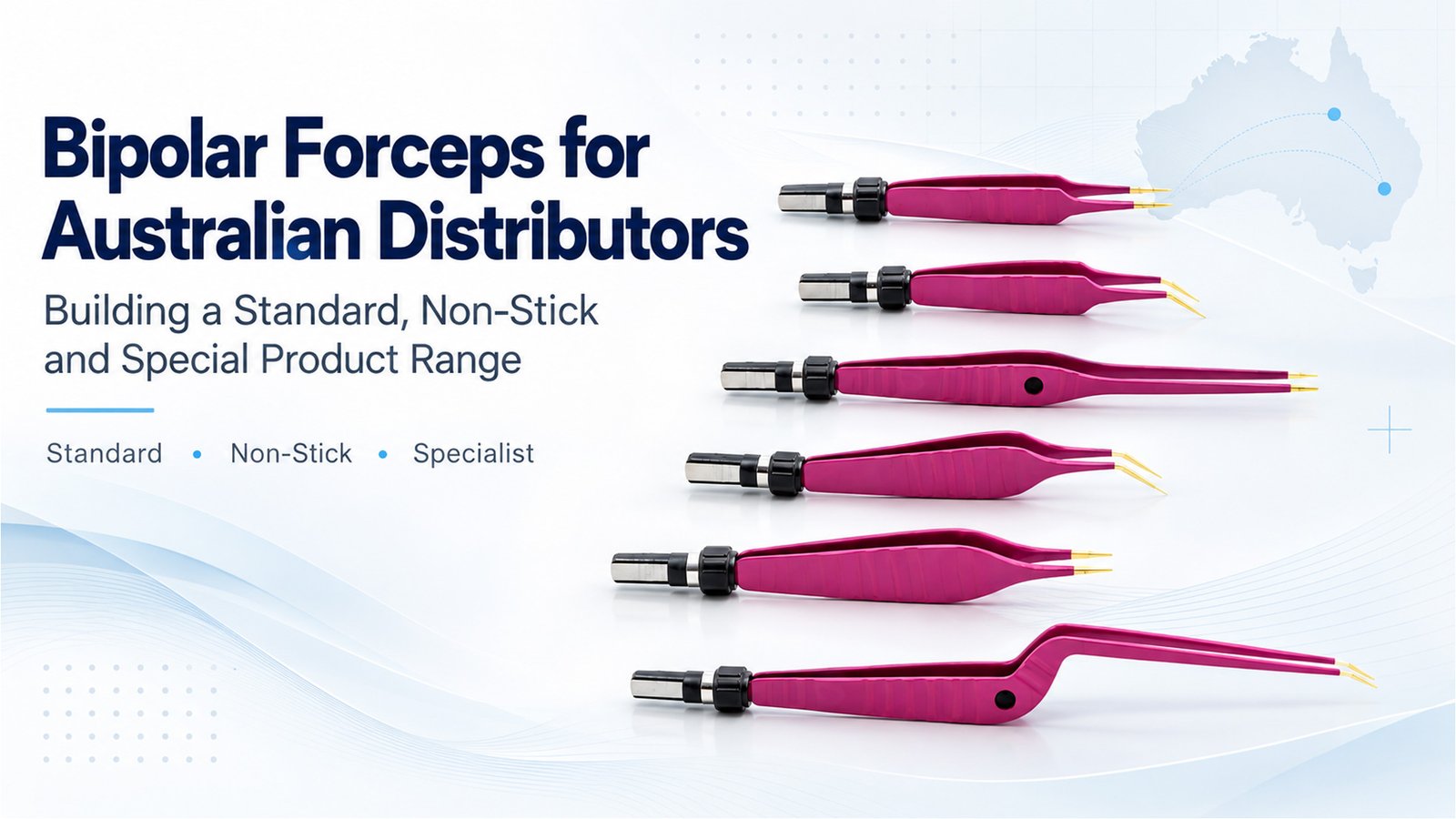
This guide is written for Australian distributors planning or expanding their bipolar forceps for distributors portfolio. It covers how to structure an opening range across standard, non-stick bipolar forceps and special bipolar forceps, how to keep product codes clean, what catalogue data each listing needs, and how to prepare quotations and forecasts for consistent repeat supply.
Quick answer: Build the range in tiers. Hold a small core of the standard configurations your customers request most, add non-stick variants as separately coded lines, and supply special bipolar forceps to order until demand justifies stock. Give every reference its own code and complete catalogue record. Treat bipolar cables and generator relationships as part of the range, and forecast by reference, not by category.
Why Range Design Comes Before Product Selection
Bipolar forceps vary along several dimensions at once. A single pattern can exist in more than one length, tip form and configuration, and in more than one product family. If each variant is added only when a customer asks for it, the catalogue slowly fills with near-duplicates that sell in small numbers and are easily confused at picking.
Deciding the shape of the range first gives the distributor control. It sets how many codes to hold, which to keep on the shelf, and which to supply against orders. It also gives sales teams a clear answer when a customer asks what is available.
Structuring an Opening Bipolar Forceps Range
A tiered structure keeps the opening range manageable while leaving room to grow as demand becomes clear.
| Tier | Purpose | What usually sits here | Stocking approach |
| Core | Cover the requests that arrive most often | Standard bipolar forceps in the patterns, lengths and configurations your customers ask for repeatedly | Held in stock with reorder points |
| Extension | Offer an alternative to core lines where customers ask for it | Non-stick variants of selected core configurations | Stocked selectively, based on customer demand |
| Specialist | Answer less frequent, specific requirements | Special bipolar forceps and irrigation forceps | Supplied to order until volumes justify stock |
The contents of each tier should come from your own customer enquiries and order history, not from a generic list. A distributor serving mainly private day-surgery clinics will build a different core from one supplying larger hospitals.
Standard, Non-Stick and Special Bipolar Forceps: What Each Adds to the Range
Standard bipolar forceps
Standard lines usually form the backbone of the range. Select them by pattern (such as McPherson, Jeweller or Adson, where listed), tip, overall length and straight, angled or bayonet configuration. Only list combinations that the specific reference actually offers.
Non-stick bipolar forceps
Non-stick bipolar forceps should be treated as their own product lines, not as an option on a standard listing. Describe the non-stick feature exactly as the reference describes it, and do not add performance claims the documentation does not support. Adding non-stick versions only of core configurations that customers already buy keeps this tier focused.
Special bipolar forceps
Special bipolar forceps cover specialist configurations, usually requested by name. Because demand is lower and more specific, supplying to order is often the sensible starting point. Our comparison of non-stick and special bipolar forceps sets out how the two families differ from a buyer’s point of view.
Cosil’s bipolar families also include C-Tech Bipolar Instruments and irrigation forceps. As with every family, confirm which patterns, tips, lengths and connectors each one offers before it goes into the catalogue.
Product-Code Separation
Clean product coding protects margin as well as accuracy. When similar instruments share a code, picking errors, returns and customer complaints follow. A few rules prevent most problems:
- One distributor code per supplier reference, with no exceptions for “equivalent” items.
- Separate codes for standard, non-stick and special versions of the same pattern and length.
- Separate codes for different connector or cable arrangements.
- Product descriptions built from the same fields in the same order, so similar codes are easy to tell apart.
Catalogue Data Each Bipolar Forceps Listing Needs
| Field | Why it belongs in the listing |
| Supplier reference and distributor code | Links every sale back to one manufactured product |
| Product family | Tells customers whether the item is standard, non-stick or special |
| Pattern, tip, length and configuration | Separates the item from its closest neighbours |
| Reusable or single-use status | Shapes the customer’s handling and reprocessing decisions |
| Cable arrangement and connector | Shows what the instrument connects to |
| Pack quantity | Defines the unit of sale and prevents order-quantity errors |
| Documentation held | Allows quick responses to customer approval requests |
For a more detailed look at the specification fields behind these entries, the bipolar forceps specification guide explains each one, and the same fields apply to an Australian catalogue.
Bipolar Cables and Connected Equipment
Bipolar forceps are only usable with the right cable and generator connection, so a distributor’s range should account for the whole connection. Where forceps use a separate bipolar cable, list the cable as its own line and record which forceps references and generator-end connectors it has been confirmed with.
Customers will use a variety of generators. Record the generator models each customer uses, and confirm the forceps, cable and generator combination for that customer instead of assuming that a connector which physically fits is suitable. Cosil’s wider range includes electrosurgical cables and plugs and electrosurgical generators. Our overview of electrosurgery equipment for Australian buyers covers how these connected products fit together.
Quotation, Forecasting and Repeat Supply
Preparing the quotation request
A distributor quotation request works best when it is organised by tier. List core references with expected annual volumes, extension references with indicative volumes, and specialist references as supply-to-order lines. Include any cable lines, private-label requirements and documentation needs, so the response covers everything required to launch the range.
Forecast quantities by reference
Forecasts are only useful at reference level. A total of “bipolar forceps per year” does not help production or stock planning. Volumes split by code do, even when they are estimates. Review forecasts against actual orders after the first few months and move lines between tiers as demand becomes clear.
Repeat supply and change control
Agree how changes to specification, packaging or labelling will be communicated before they happen, and check incoming stock against the catalogue record. This protects the distributor from passing on an unannounced change to customers.
Australian Distribution Considerations
Australian distributors often serve customers across several states and a mix of public hospitals, private hospitals and day-surgery clinics. That makes accurate records and dependable reorder cycles especially valuable. Distance between the manufacturer and the end customer rewards a range that is planned, not assembled reactively.
Before listing any reference, distributors should confirm its regulatory position for supply in Australia through their own compliance process. This applies to each reference individually and cannot be inferred from a related product. Distributors considering their own branding can review Cosil’s OEM and private-label manufacturing. For supply arrangements specific to Australia, see Bipolar Forceps Supplier Australia.
Building a Bipolar Forceps Range That Grows with Demand
The strongest bipolar forceps ranges for distributors start small, stay clearly coded and expand in response to real customer demand. A tiered structure across standard, non-stick and special lines, complete catalogue data, confirmed cable and generator relationships, and reference-level forecasts give Australian distributors a range they can sell with confidence and resupply without surprises. Product suitability for end users remains subject to their own clinical, technical and procurement review.
Frequently Asked Questions
How many bipolar forceps references should a new distributor range include?
There is no fixed number. Start with the configurations your customers already request most often, add non-stick variants where demand exists, and keep specialist lines to order until volumes justify stock.
Should non-stick bipolar forceps share a code with the standard version?
No. They are different products and should each have their own code and catalogue record.
Do we need to stock bipolar cables as well?
Where forceps connect to a separate cable, customers will need a confirmed cable and connector for their generator. Listing cables as their own lines makes that easier to supply accurately.
Can Cosil supply bipolar forceps under our own brand?
Cosil offers OEM and private-label supply. Requirements, quantities and documentation should be discussed as part of the quotation.
Who confirms regulatory status for Australian supply?
The distributor should confirm the regulatory position of each reference for Australia through its own compliance process before listing it.
Plan Your Bipolar Forceps Range with Cosil
If you are building or expanding a bipolar forceps range for Australian customers, send your proposed core, extension and specialist lines, together with forecast volumes and generator information, to sales@cosilinstruments.com. You can also explore the product families at Cosil Instruments.