
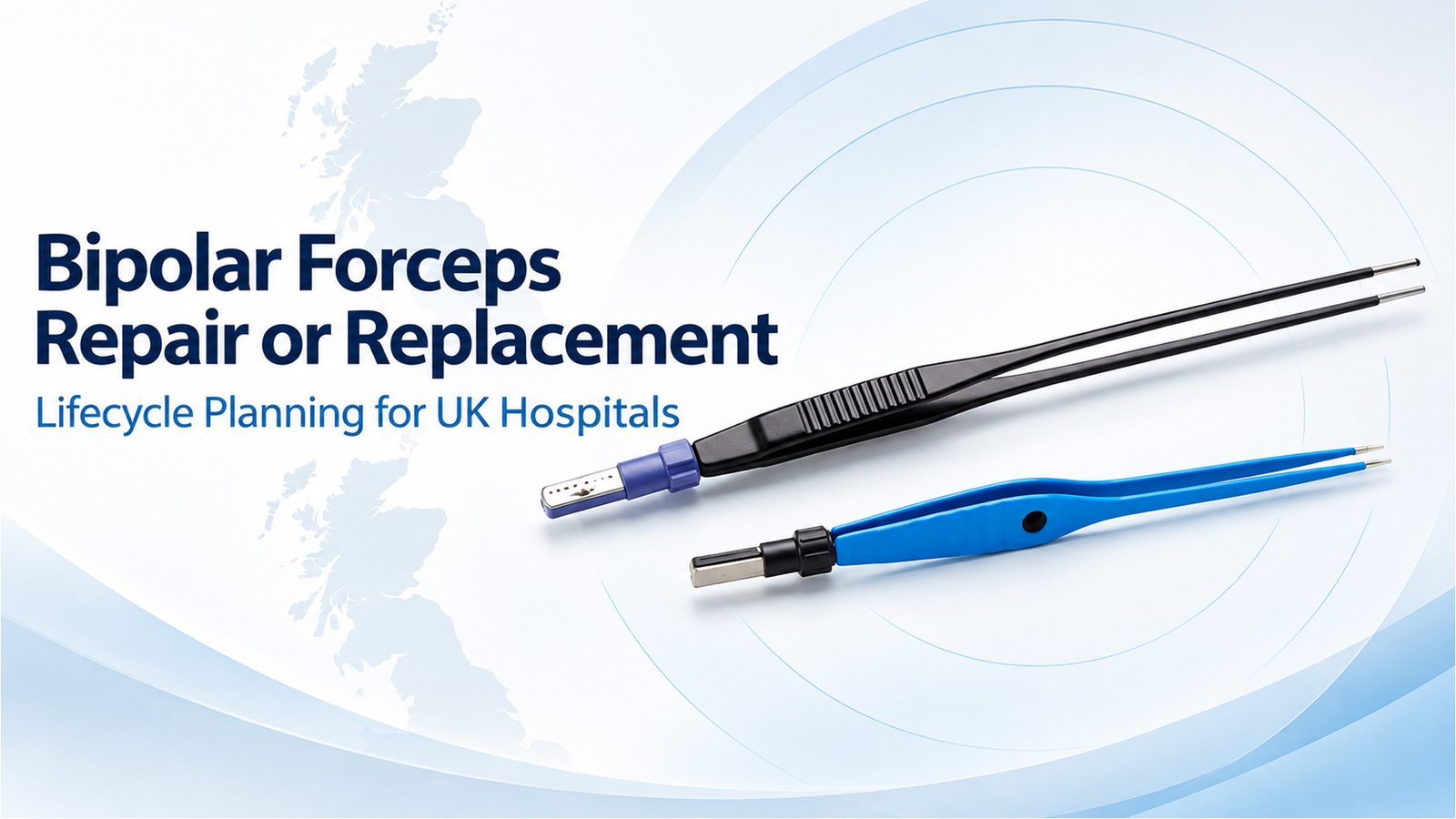
When a reusable bipolar forceps comes back from inspection with a fault, the decision should already be written down 🔄
Every reusable bipolar forceps eventually reaches the end of its working life. Insulation wears, tips lose alignment, connector pins corrode. In many UK hospitals, what happens next is decided case by case: a sterile services technician sets the instrument aside, someone in theatres asks whether it can be fixed, and procurement is asked for a replacement at short notice. The result is often a gap in the instrument set and a rushed purchase.
This guide looks at bipolar forceps repair and replacement from a lifecycle-planning point of view. It explains which faults are commonly considered for repair and which usually lead to replacement, how to plan instrument pools so a withdrawal does not leave a list short, and what information UK buyers should request from manufacturers to make those decisions consistently. Cosil Instruments manufactures bipolar forceps; this page does not describe a Cosil repair service, and any repair decision should follow the manufacturer’s instructions and local policy.
Quick answer: Reusable bipolar forceps should be withdrawn, repaired or replaced according to the manufacturer’s instructions and the hospital’s decontamination and medical device policies. Damaged insulation, misaligned or damaged tips, and faulty connectors are the usual reasons for withdrawal. UK hospitals can avoid shortages by setting written withdrawal criteria, tracking withdrawals by reference, planning instrument pools with a margin, and agreeing replacement routes with suppliers in advance.
Why Lifecycle Planning Matters
A bipolar forceps that fails inspection is removed from use. If no replacement is available, the tray goes out incomplete, a substitute is borrowed from another set, or a list is delayed. None of these is a good outcome, and all are avoidable with a little planning.
Lifecycle planning answers three questions before they arise:
- What faults lead to withdrawal?
- Is repair an option for this instrument, and who may carry it out?
- How quickly can a replacement be obtained, and how many spares should be held?
Key insight: Write the withdrawal and replacement rules down before the first instrument fails. A decision made in advance is faster and more consistent than one made at the sterile services bench.
Common Reasons Bipolar Forceps Are Withdrawn
| Fault | Why it matters | Typical outcome |
| Damaged insulation (cracks, chips, wear) | Insulation may no longer insulate as intended | Withdraw; repair only if the manufacturer’s instructions allow it |
| Misaligned tips | Tips must meet correctly to work as intended | Withdraw; some hospitals send for professional realignment where permitted |
| Damaged or worn tips | Tip surface and geometry affect function | Withdraw and replace in most cases |
| Damaged non-stick coating | Coating may no longer perform as intended | Withdraw; follow manufacturer guidance |
| Connector damage (bent pins, loose housing) | Poor or unsafe connection to the cable | Withdraw; repair or replace per policy |
| Blocked irrigation channel | Cannot be reliably cleaned | Withdraw; replace if cleaning cannot be restored |
Non-stick and irrigation designs add their own inspection points. Our guides to irrigation bipolar forceps and non-stick and special bipolar forceps explain how those designs differ from standard insulated forceps.
The manufacturer’s instructions for use and the hospital’s own medical device and decontamination policies determine the final decision. Our guide to bipolar forceps reprocessing in the UK explains the inspection information sterile services teams need.
Repair: Questions to Settle in Advance
Some hospitals use third-party repair services for reusable surgical instruments. For insulated electrosurgical instruments, repair raises specific questions:
- Do the manufacturer’s instructions permit repair, and of which faults?
- Who is qualified to carry out the repair, and how is the repaired instrument verified?
- Does re-insulation by a third party change who is responsible for the device?
- How is the repaired instrument identified and traced afterwards?
These questions should be answered by the hospital’s medical device governance, not by individual departments under time pressure. Where there is doubt, replacement is usually the simpler route.
Planning the Instrument Pool
The number of bipolar forceps a hospital needs depends on more than the number of trays. A practical calculation includes:
- lists per week that use each pattern;
- reprocessing turnaround from theatre back to theatre;
- a withdrawal margin, based on how often instruments fail inspection;
- repair or replacement lead time;
- single-use back-up for lists where a reusable instrument may not be available. See single-use forceps for UK buyers.
Tracking withdrawals by reference and reason makes the margin evidence-based rather than a guess. If one pattern is withdrawn more often than others, it may need a larger pool, different handling or a review of whether a different design suits the use better.
Replacement Routes
Agree replacement routes with suppliers before they are needed:
- reference-level ordering, so a replacement matches the withdrawn instrument exactly;
- expected lead times for common patterns;
- a small buffer stock of the most-used patterns, held in stores rather than in circulation;
- single-use alternatives, such as single-use bipolar forceps with integrated cable, for urgent cover.
Cosil Instruments manufactures reusable insulated bipolar forceps in many patterns and lengths, non-stick and irrigation designs, and single-use bipolar forceps with integrated cable. See our main bipolar forceps for the UK page.
Key insight: Hold the most-used bipolar forceps patterns as a small replacement buffer in stores. It turns an inspection failure into a routine swap instead of an emergency order.
Information to Request From Manufacturers
To support lifecycle decisions, request for each reusable reference:
- inspection criteria for insulation, tips, coating, channel and connector;
- withdrawal criteria;
- the manufacturer’s position on repair, including any faults that may be repaired and by whom;
- reference codes that allow an exact replacement to be ordered;
- lead times for replacement stock.
Our bipolar forceps specification guide for the UK explains the reference details that make exact replacement possible.
Linking Lifecycle Data to Procurement
Withdrawal records are useful procurement data. Reviewed every quarter, they show:
- which patterns fail most often;
- whether failures cluster after a certain number of cycles or months;
- whether a particular handling step, such as packing, is causing damage;
- whether a different design or a single-use option would serve a list better.
Sharing a summary with the supplier helps both sides. A manufacturer can review whether its instructions need clarifying, and the hospital gets better evidence for the next contract review.
UK Documentation and Regulatory Checks
For each bipolar forceps reference, UK buyers should hold the declaration of conformity, labelling, instructions for use and reprocessing information. For devices placed on the Great Britain market, UK Responsible Person, MHRA registration and post-market surveillance duties continue to apply. On 21 October 2026 the UK government confirmed it intends to legislate for indefinite recognition of devices CE-marked under the EU MDR; check the current position at tender time.
Cosil’s website refers to CE certification with SGS Belgium as notified body, ISO 13485:2016 and EUDAMED registration, and notes that MDR certification is in progress. Request current certificates and check their scope. See our quality policy and the wider guide to electrosurgical insulated forceps.
Frequently Asked Questions
When should a bipolar forceps be withdrawn?
When inspection finds damaged insulation, misaligned or damaged tips, damaged coating, a blocked channel or a faulty connector, according to the manufacturer’s instructions and local policy.
Can bipolar forceps be repaired?
That depends on the manufacturer’s instructions, the fault and the hospital’s medical device governance. Decide in advance which faults may be repaired, by whom, and how repaired instruments are verified.
How many spare bipolar forceps should a hospital hold?
Enough to cover reprocessing turnaround and the observed withdrawal rate, plus a small buffer of the most-used patterns. Withdrawal data makes this calculation more accurate.
Does Cosil offer a repair service?
This page does not describe a Cosil repair service. Cosil manufactures reusable and single-use bipolar forceps and can provide reference details for exact replacements.
Can single-use forceps cover a shortage?
They can provide back-up for some lists, subject to clinical approval and generator compatibility of the integrated plug.
What records help with lifecycle planning?
Withdrawals by reference and reason, reprocessing turnaround, and replacement lead times.
Plan the End at the Start
Bipolar forceps lifecycle planning is simple once it is written down: clear withdrawal rules, an agreed position on repair, a sensible instrument pool and a fast replacement route. UK hospitals that put these in place keep trays complete and lists on time.
Planning bipolar forceps replacement stock for a UK hospital? Contact Cosil Instruments at sales@cosilinstruments.com or +92 331 732 7777, or send your pattern list, to request reference details and a quotation.