Build one accurate record per reference, and Swiss hospitals, specialist clinics and distributors can reorder bipolar forceps with confidence
Swiss procurement tends to reward precision. Hospital purchasing departments, specialist clinics and distributors all keep product records that must stay accurate across repeat orders, internal approvals and, for distributors, their own customers’ requirements. For bipolar forceps in Switzerland, that makes the product record as important as the instrument: if the record is vague, every reorder becomes a fresh selection exercise.
This guide shows how to select bipolar forceps and build a reference-level record Swiss buyers can rely on. It covers the product family, dimensional details, connection information, documentation and the practical steps that keep repeat purchasing consistent. It does not replace the buyer’s own clinical, technical or compliance review, and it makes no claims about Swiss regulatory status, which must be assessed for each specific reference.
Quick answer: Procure bipolar forceps in Switzerland by confirming the product family, then recording one reference with its pattern, tip, length, configuration, cable and connector details, the generator it has been confirmed with, and the documentation received for that exact reference. Use that record for every quotation and reorder, and treat any alternative as a new approval rather than a substitution.
Why Bipolar Forceps Procurement in Switzerland Works Best at Reference Level
Bipolar forceps that look alike can differ in tip geometry, length, insulation, coating or connector. A description such as “bayonet bipolar forceps, non-stick” may match several products. A product reference matches one.
Working at reference level gives Swiss buyers three practical benefits. Quotations can be compared like for like. Approvals and documentation stay attached to the product they were issued for. Reorders arrive as the same instrument, which is what theatre and clinic staff expect.
Selecting the Bipolar Forceps Product Family
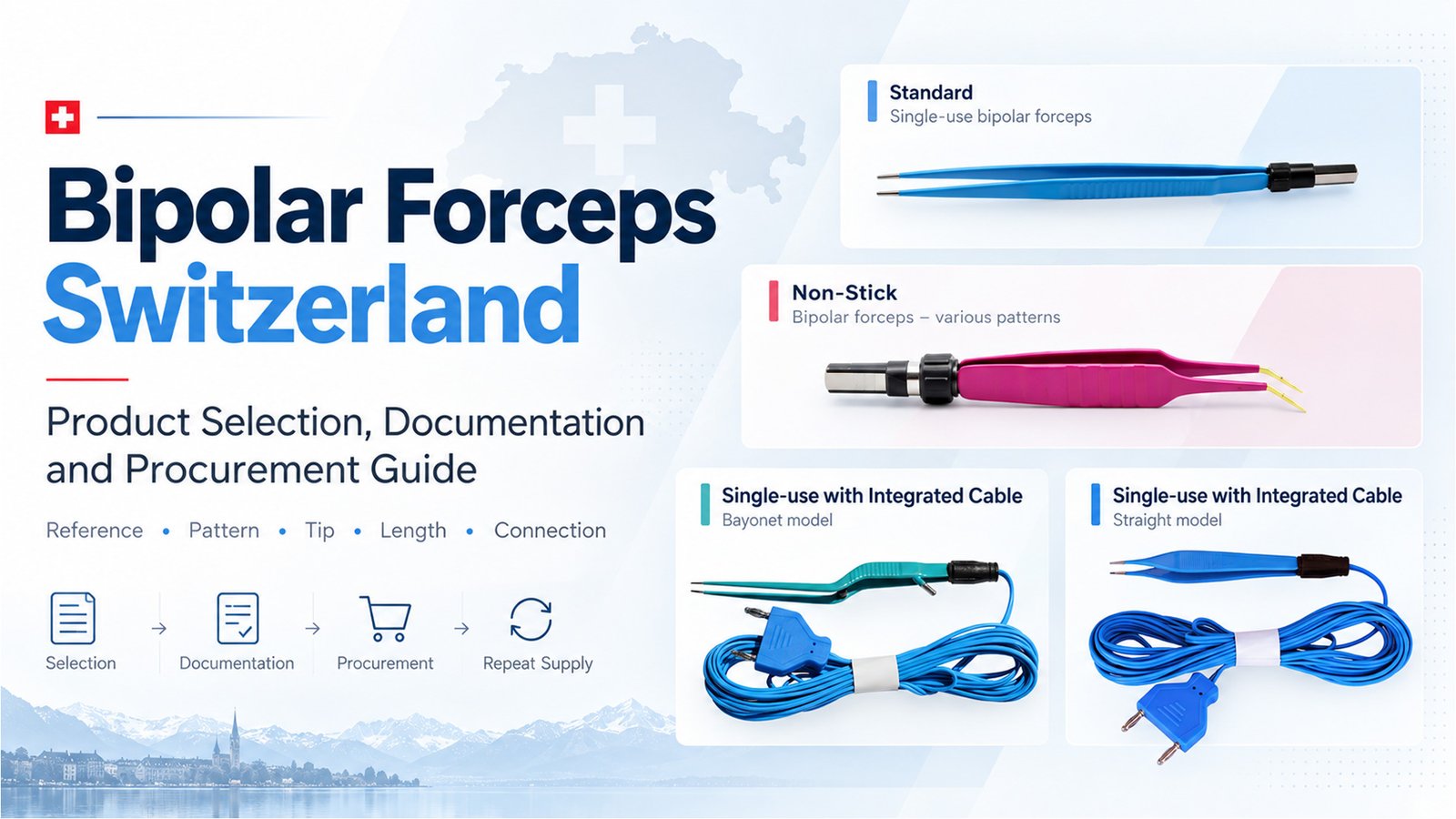
Start by identifying the family, because it limits which patterns, tips, lengths and connectors are available. Cosil’s bipolar range can include:
| Product family | What to confirm before recording |
| Standard bipolar forceps | Pattern, tip, length and cable arrangement listed for the reference |
| C-Tech Bipolar Instruments | Which configurations are offered within this family |
| Non-stick bipolar forceps | Non-stick feature as described for the reference, plus dimensions |
| Special bipolar forceps | The specific specialist configuration and how it differs from standard |
| Irrigation forceps | Irrigation arrangement and any additional connection requirements |
For help choosing between the two most commonly compared families, see non-stick vs special bipolar forceps. The bipolar forceps range shows how the families are presented.
Building the Bipolar Forceps Reference Record
A useful Swiss product record holds everything needed to reorder, receive and verify the instrument without going back to the supplier for clarification.
Identification
Record the supplier’s product reference, the product family and your own internal or catalogue code. Where a customer or clinic uses a different name for the instrument, record that as an alias, not as a separate item.
Pattern, tip and length
Note the pattern (for example McPherson, Jeweller or Adson where listed), the tip as described for the reference, the overall length and the configuration: straight, angled or bayonet. These fields separate one reference from its nearest neighbours.
Connection details
Record the cable arrangement, the instrument-end connection, the generator-end connector and the generator model the combination has been confirmed with. A connector that fits a socket does not by itself establish electrosurgical compatibility. The record should reflect a confirmed pairing, not an assumption. The compatibility guide explains what to check.
Use and reprocessing status
Note whether the reference is reusable or single-use. For reusable instruments, record the instructions for use that cover inspection and reprocessing. For single-use instruments, record sterile status as confirmed from the packaging and documentation. Single-use does not in itself mean sterile. Single-use bipolar sourcing is covered in our guide to single-use forceps in Switzerland.
Documentation to Request and Hold for Bipolar Forceps in Switzerland
Each Swiss organisation decides which documents its own approval processes require. The practical rule is that every document should be linked to the reference it was issued for and dated when received.
| Document or information | Purpose in the record |
| Product specification | Confirms the dimensional and connection details recorded |
| Instructions for use | Supports clinical, technical and reprocessing review; buyers may ask which languages are available |
| Labelling and packaging information | Supports goods-in checks and identification of the reference and batch |
| Regulatory and conformity information | Allows the buyer’s compliance function to assess the reference against its own obligations |
| Quality management information | Supports supplier approval; see Cosil’s quality policy |
Documentation for one reference should never be filed against another, even within the same family. If a reference changes, its documentation set should be reviewed again.
Bipolar Forceps for Swiss Hospitals and Specialist Clinics
Hospital purchasing departments
Hospitals often buy across several departments that use different generators and prefer different patterns. Keeping one record per reference, with generator pairings noted, stops one department’s specification from being applied to another’s order. Grouping records by product family also makes it easier to see where the range can be simplified.
Specialist clinics
Smaller clinics may buy lower volumes but depend heavily on getting the same instrument each time. A short, accurate record (reference, tip, length, configuration, connector and generator) is usually enough to make reorders simple. Clinics that also need single-use options can hold those as separate records.
For supplier-level information on how Cosil supports Swiss buyers, see Bipolar Forceps Supplier Switzerland and the broader electrosurgical forceps supply for Switzerland.
Swiss Distributors: Catalogue Records and Repeat Purchasing
Catalogue records
Distributors carry the record forward to their own customers. That makes accuracy important twice: once when buying and once when selling. Each catalogue entry should map to one supplier reference, with non-stick and special variants kept as separate codes instead of options under a single listing.
Repeat purchasing and change control
Share forecasts by reference so supply planning reflects real demand. Agree in advance how changes to specification, packaging or labelling will be notified, and update the record and documentation set before changed stock is released to customers. The medical distributor sourcing guide covers wider supplier-management considerations.
Common Bipolar Forceps Record Errors and How to Prevent Them
| Error | Consequence | Prevention |
| Recording by description only | Different products supplied against the same order line | Record the supplier reference as the primary identifier |
| Merging non-stick and standard variants | Customers receive a variant they did not expect | Separate codes for each family and variant |
| Omitting the generator pairing | Connector confirmed for one site is ordered for another | Record the generator model with each confirmed connector |
| Filing documents against the family | Documentation does not match the reference supplied | Link and date every document to one reference |
| Assuming sterile status from “single-use” | Incorrect storage or handling decisions | Confirm sterile status from packaging and documentation |
Making Bipolar Forceps Switzerland Procurement Repeatable
Swiss buyers get the most consistent results by choosing the product family first and then maintaining one complete, documented record per reference. That record makes quotations comparable, approvals traceable and reorders predictable, whether the buyer is a hospital, a specialist clinic or a distributor. Final product suitability always rests with the buyer’s clinical, technical, procurement and compliance review.
Frequently Asked Questions
What should a Swiss bipolar forceps record contain?
The supplier reference, product family, pattern, tip, length, configuration, cable and connector details, the generator the combination was confirmed with, reusable or single-use status, and the documentation received for that reference.
Can non-stick and standard bipolar forceps share one catalogue code?
This is not recommended. They are different products, and keeping them under separate codes prevents unintended substitution.
Does Cosil provide Swiss regulatory documentation for bipolar forceps?
Documentation availability is confirmed per reference. Buyers should state what their approval process requires, and their own compliance function should assess the information provided.
How do we handle an alternative reference offered during supply?
Treat it as a new product: build a separate record, obtain its own documentation and complete your normal approval before it replaces the original.
Is a specification guide available for UK buyers?
Yes. The bipolar forceps UK specification guide covers tip, length, insulation and connection fields in more depth. Swiss buyers can use those fields when building their own records.
Build Your Swiss Bipolar Forceps Records with Cosil
Whether you are approving bipolar forceps for a Swiss hospital or clinic or setting up distributor catalogue records, send your required families, patterns, dimensions, generator details and documentation needs to sales@cosilinstruments.com. Explore the full range at Cosil Instruments.